Friday, March 13, 2015

Friday, March 6, 2015
Matt Kornis: Former Sea Grant Student Now Works With Millions of Fish
March 2, 2015
By Marie Zhuikov
Matt Kornis’s mother likes to tell the story of how they would walk in the neighborhood when Matt was two and he would pick up a stick to “fish” for leaves in puddles. Later, in college, his love for water, fish and the outdoors won out over his interest in molecular biology, leading to his current job with the U.S. Fish and Wildlife Service (USFWS) in Green Bay, Wis. Kornis is a fish biologist and data analyst with the Great Lakes Mass Marking Program, a multi-agency study across the Great Lakes that involves implanting coded wire tags into millions of stocked fish each year to help assess the effectiveness of the stocking program for lake trout and Chinook salmon.
Kornis was working on his undergraduate degree in biology at Lawrence University in Wisconsin when he applied for several internships in molecular biology or fisheries. As fate would have it, he received a fisheries internship with University of Wisconsin-Milwaukee’s John Janssen to look at alewife diets and habitat selection in Lake Michigan.
“I loved being outside every day during the summer, looking at different fish, analyzing at data and using it to answer questions,” Kornis said. And his fisheries career began. Kornis pursued both his master’s and Ph.D. in limnology and marine science at UW-Madison with the help of Wisconsin Sea Grant funding. He worked with Professor Jake Vander Zanden at the Center for Limnology on projects that explored the expansion of the invasive round goby into streams that enter Lake Michigan.
By identifying the environmental characteristics of the streams where round gobies were found, they were able to create a computer model to predict the gobies’ range expansion. Kornis also helped discover that round gobies may have more of an impact on native stream species when found at low densities than at high densities.
This led to a post-doctoral fellowship with the Smithsonian Environmental Research Center in Maryland where Kornis was able to explore the marine part of his degrees. He looked at how land use in the Chesapeake Bay watershed combined with shoreline alteration to impact fish and shellfish. A major finding of his work was that wetland loss and shoreline hardening (construction with cement, rock or other hard materials) have negative effects on the abundance of many species. Kornis also explored how phragmities, an invasive wetland plant, affects nearshore fish communities.
“Every summer, my life was dictated by the moon,” Kornis said, “because it affects the tides, and we could only sample during certain tidal phases,” which was definitely something Kornis did not have to consider when he worked in the Great Lakes.
After three years at the center, Kornis, a native of Glendale, Wis., moved back to Wisconsin to work for the Great Lakes Mass Marking Program. With the help of an automated process that can handle over 8,000 fish per hour, USFWS biologists have inserted tiny coded wire tags into the snouts of 16 million Chinook salmon and 28.5 million lake trout stocked into lakes Michigan and Huron since 2010. The tags, which look like small pieces of mechanical pencil lead, rest in the cartilage of the fish’s snout and contain numerical codes that denote what hatchery the fish are from and where they were stocked. The fish’s adipose fin (the small fleshy fin located behind the dorsal fin on the top of each fish) is clipped as a visual marker that the fish is tagged.
The tags are retrieved later by fisheries managers, sport anglers, commercial fishermen, and “head hunters” – USFWS tag recovery technicians who haunt fishing tournaments and fish cleaning stations to assess fish caught by anglers willing to participate in the program.
Each tag is painstakingly extracted from the fish’s snout by hand and read under a microscope for its code. Nearly 50,000 tags have been recovered since the program’s inception, providing information on two important Great Lakes fisheries.
“Chinook salmon and lake trout fisheries contribute to a 7-billion-dollar-per-year industry,” said Kornis. “The importance of these fisheries to the Great Lakes region can’t be understated, and we’re processing information to help enhance our understanding of that fishery.”
The boy who used to fish in puddles has come a long way.
Gobies Compete With Each Other When Crowded, Sparing Native Fishes
March 2, 2015
By Marie Zhuikov
It seems counter-intuitive, but Wisconsin Sea Grant researchers have found that an invasive fish, the round goby, may have greater impacts on native fishes when there are fewer gobies rather than gobs of gobies. The reason? The round goby (Neogobius melanostomus) is so pugnacious and aggressive to their own kind that when numbers are high, they compete among themselves to a greater extent than against native fishes. Round gobies were mostly likely introduced to America in the ballast water of European ships.
University of Wisconsin-Madison Professor Jake Vander Zanden and former Ph.D. student Matthew Kornis and their team published their findings last year in the journal Oecologia. They stocked 18 enclosures in Little Suamico River, a tributary of Lake Michigan in northeastern Wisconsin, with gobies and three species of native fishes (creek chubs, white suckers and Johnny darters).
The enclosures contained the same amounts and types of natural food. The only difference was the numbers of gobies: from “no goby” to “low goby” (2.7 fish per square meter) to “high goby” (10.7 fish per square meter). The fish lived in enclosures made from PVC pipe and plastic mesh for 52 days and were weighed at the beginning and end of the experiment.
The lowest growth rates in the native fishes were in the low-goby enclosures, with Johnny darters and white suckers faring worst. Native fish growth in the high-goby enclosures was no different than in the enclosures without gobies.
“Gobies are super-territorial and they beat up on other gobies in these experimental settings,” said Vander Zanden. “We believe that because they’re spending their time competing with other gobies, their impact on other species is reduced at high densities.”
Vander Zanden said they were surprised by this result “because there’s an implicit assumption that presence corresponds with impacts, and that if you increase an invasive’s abundance, its impact would increase.”
Kornis explained that, “Although this type of finding isn’t entirely new, it has not been shown for an invasive species before in terms of its effect on native species.” He said that in addition to competing for food, gobies, which can spawn up to six times per season, are also intense rivals for mates.
Although the finding is specific to round gobies, Vander Zanden said it addresses broader issues in invasion science. “Don’t always assume that just because something is more abundant that it’s going to have more impact,” he said. This can be helpful to natural resource management agencies. “Understanding how species have different impacts on different ecosystems is helpful in determining where to put our increasingly limited resources so that we get the most bang for the buck,” Vander Zanden said.
This experiment was part of a larger project that looked at the presence and impacts of round gobies in Great Lakes streams. Several years ago, Vander Zanden’s students found gobies in streams that drain into Lake Michigan. “We were just shocked that this species that lives in huge lakes was moving into these tiny little streams because they’re such a different habitat,” Vander Zanden said. “Even in their native range in the Black and Caspian seas in Europe, they only live in large rivers and lakes.”
He set Kornis on the case, who confirmed that the gobies were living and expanding their range upstream every year by a third- to a half-mile. “For a fish that normally has a small home range – like the size of a person’s living room – this is a very rapid range expansion,” Kornis said. He suspects the pressure of living in the higher stream temperatures and finding food, which is relatively less abundant in streams, may be the cause of their spread. “Unlike many native species, round gobies are built to feed on zebra mussels and quagga mussels, which are plentiful in the Great Lakes but usually absent in streams. Gobies in streams must compete with every other fish for the same food,” Kornis said. He developed a simulation model that predicts the gobies’ range expansion in streams.
Thursday, February 19, 2015

Kids Fishing Clinic Menomonee Park 2015
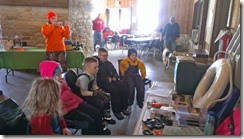
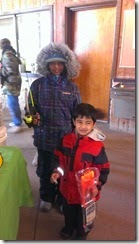
The temperature was eight degrees and wind gusts up to 40 MPH but that didn’t keep these kids from attending the 24th Annual Kids Ice Fishing Clinics held on Saturday, Feb.14. The Clinics took place in seven area parks in Milwaukee and Waukesha counties.
There was a total of 163 kids with 75 volunteers from the local fishing clubs that did their best under adverse conditions to teach kids about fishing.
Below are photos from Menomonee Park/Lannon Quarry, Townline Rd. (1/2 mile north of Good Hope Rd., Menomonee Falls), which was hosted by Badger Fishermen’s League. Thanks to Brenda Rosin-Schaff for providing the pictures.



Click on photos to enlarge


Wednesday, February 4, 2015
24th annual Kids Ice Fishing Clinics set for Saturday, Feb.14
MILWAUKEE – Kids 15-years-old and younger are invited to discover the joys of ice fishing at the 24th annual Kids’ Ice Fishing Clinics on Saturday, Feb. 14, at park lagoons in Milwaukee and Waukesha counties.
The free clinics will be held from 9 a.m. to 3 p.m. Participants will receive instruction on the proper use of equipment and techniques, such as knot tying, ice safety and much more. The clinics are taught by members of local fishing clubs and last 45 minutes, and then the young anglers can begin fishing. Classes begin every hour on the hour starting at 9 a.m., with the final session beginning at 2 p.m.
“These clinics are an excellent way to introduce youngsters to the sport of fishing and a perfect opportunity for families that want to enjoy some of the outdoor recreational activities that Wisconsin has to offer,” says Department of Natural Resources Secretary Cathy Stepp,
The clinics represent a cooperative effort by the Wisconsin Council of Sport Fishing Organizations, Milwaukee County Parks, Waukesha County Parks, the Hunger Task Force Fish Hatchery and the Department of Natural Resources.
All equipment and snacks are provided free of charge and instructions will be given regardless of weather. No pre-registration is required, but please call DNR Urban Fish Biologist Matt Coffaro at 414-263-8614 for groups of 20 or more, or for additional information. Listed below are the clinic locations and sponsoring fishing clubs:
Milwaukee County
Humboldt Park, 3000 S. Howell Ave., hosted by Great Lakes Sport Fishermen & Milwaukee Casting Club
McCarty Park, 8214 W. Cleveland, hosted by Southside Sportsmen Club
Brown Deer Park, 7835 N. Green Bay Rd., hosted by Okauchee Fishing club
Scout Lake, 5902 W. Loomis Rd., (wheelchair accessible) hosted by Walleyes Unlimited
Wilson Park, 1601 W. Howard Ave., hosted by Wisconsin Fishing Club
Waukesha County
Menomonee Park/Lannon Quarry, Townline Rd. (1/2 mile north of Good Hope Rd., Menomonee Falls), hosted by Badger Fishermen’s League
Fox Brook Park, 2925 N. Barker Rd., hosted by Wern Valley Sportsman’s Club
Subscribe to:
Posts (Atom)