Showing posts with label Michigan News. Show all posts

Thursday, April 16, 2015

Cooperative project by Wisconsin and Michigan DNR teams to bring benefits for Brule area anglers

FLORENCE, Wis. — A cooperative project by Wisconsin and Michigan fisheries managers aims to collect population and breeding data on an important native strain of walleye while providing fingerlings uniquely suited for a regional stocking effort.close-up of walleye caught in Michigan
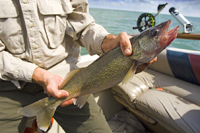

Mike Vogelsang, north district fisheries supervisor for the Wisconsin Department of Natural Resources, said the research is taking place on the Brule River, which is home to a relatively pure strain of Lake Michigan walleye. The river meanders to separate Wisconsin’s Florence and Forest counties from Michigan’s Iron County before it eventually reaches the Menominee River and flows into Lake Michigan.


The river features more than 27 miles of cold class I trout waters and its impoundment areas serve as the perfect home to a strain of Lake Michigan walleye that has been largely unaffected by the hybridization seen in other waters following a variety of stocking efforts over the years.


“These fish are the best example of Lake Michigan strain walleye in the area,” Vogelsang said. “This is really a science-based way to approach stocking in that you want to find a source of fish that is native to a drainage basin. This walleye strain has evolved over time to be in these waters, so it is best suited for the area genetically.”


The main focus of the cooperative research involves an assessment of the age structure and health of walleye in the area. Thanks to access granted by Michigan fisheries staff, Wisconsin team members from the Florence field office and the Art Oehmcke Hatchery will place nets in more than a dozen locations in the waters of both states in the days ahead.


Walleye captured in the nets will be measured and weighed and a scale sample will be taken to determine age. Fish that are ready to spawn will contribute eggs and milt with a goal of harvesting some 1.7 million eggs.


Given that each adult female walleye carries on average about 70,000 to 80,000 eggs, the team hopes to come up with about 20 to 30 ripe females and at least as many males. After all the fish have been weighed and processed, they will be returned to the river.


“The strong working relationship that has developed between our states and in particular, our fisheries teams, makes this type of cooperative research possible,’’ said Darren Kramer, Northern Lake Michigan Unit manager with the Michigan Department of Natural Resources. “We anticipate gaining valuable insights from this work that will help inform our efforts in the jointly managed fishery going forward.”


In addition to assessing the overall health of the walleye population, the research effort also will involve northern pike, bass and panfish — other popular targets of recreational anglers in the region.


Vogelsang said the walleye egg collection effort is expected to produce approximately 30,000 fish for stocking in Forest and Florence counties as part of the Wisconsin Walleye Initiative. The fish will be reared at the Oehmcke facility in Woodruff and will be stocked as 5 to 6 inch extended growth fingerlings in September.
“We appreciate the support of the Michigan fisheries team and have seen benefits to both states from past efforts involving musky stocking, genetics work and other research,” Vogelsang said. “The more we learn, the better we are able to implement best practices in maintaining healthy fish populations in our border waters.”


To learn more about walleye stocking efforts, visit dnr.wi.gov and search “Wisconsin Walleye Initiative.” More information about Michigan’s fisheries management efforts can be found by visiting Michigan.gov/dnr and searching for “Walleye Better Fishing Waters.”


Thursday, May 22, 2014

Join the Grand American Fish Rodeo in Lansing

Grand American Fish RodeoLooking for something fun to do in mid-Michigan this June? Visit Adado Riverfront Park in Lansing June 12, 13 and 14 for the inaugural Grand American Fish Rodeo!
This event is centered on Michigan’s rich heritage of water and aquatic life and features a variety of activities. The Department of Natural Resources is involved in the Grand American Fish Rodeo as part of the Educational Tent which will offer numerous activities for those in attendance.
A few things you can see and do if you visit the tent:
•    Hands-on learning and craft activities for all ages
•    Casting a fishing rod
•    Tying knots and learning how flies are tied
•    Seeing live sea lamprey and lake sturgeon
•    Seeing how a boat washing unit works
•    Viewing a fish stocking truck and air boat up close
•    Taking your picture with “Primo” from Preuss Pets
Check out the Fish Rodeo Educational Tent flyer to discover all the fun that will be offered! The educational tent will be open Friday, June 13 from 12 to 7 p.m. and Saturday, June 14 from 10 a.m. to 6 p.m.
There are also many more events featured at the Rodeo, so check out their website for all the details: www.grandamericanfishrodeo.com.

Fish for free in Michigan June 7 & 8

The annual Summer Free Fishing Weekend is scheduled for Saturday, June 7 and Sunday, June 8. On that weekend, everyone – residents and non-residents alike – can fish without a license, though all other fishing regulations still apply.
Michigan has been celebrating the Summer Free Fishing Weekend annually since 1986 as a way to promote awareness of the state's vast water resources. With more than 3,000 miles of Great Lakes shoreline, 11,000 inland lakes, and tens of thousands of miles of rivers and streams, fishing and Michigan go hand in hand.
To encourage involvement in Free Fishing Weekends, organized activities are being scheduled in communities across the state. These activities are coordinated by a variety of individuals, organizations, constituent groups, schools, local and state parks, businesses and others. To find an event in your area, visit www.michigan.gov/freefishing.

Thursday, May 15, 2014

Multiple openers in Upper Peninsula kick fishing season into high gear

The Department of Natural Resources reminds anglers to get ready for the fishing seasons that open Thursday in the Upper Peninsula. Seasons for walleye, northern pike and muskellunge and the catch-and-immediate-release bass season for all Upper Peninsula waters, including the Great Lakes, inland waters and St. Marys River, all open May 15.

The possession season for bass opens statewide Saturday, May 24, except for Lake St. Clair, the St. Clair River and the Detroit River, which opens Saturday, June 21.

Michigan’s bass fishing is considered world-class, as exhibited by Bassmaster magazine's 100 Best Bass Lakes of 2014 where six of the state’s waters were listed. To see the full list, visit www.bassmaster.com/top100.

The new license season began April 1, so anglers need to be sure they have purchased a new fishing license for this fishing season. The 2014 fishing licenses are valid through March 31, 2015. Licenses are available at retailers or online at www.mdnr-elicense.com.

The 2014 Michigan Fishing Guide and inland trout and salmon regulations and maps are available online; visit the DNR website at www.michigan.gov/fishingguide for more information.

Fishing in Michigan

Looking for something fun to do in mid-Michigan this June? Visit Adado Riverfront Park in Lansing June 12, 13 and 14 for the inaugural Grand American Fish Rodeo!Grand American Fish Rodeo

This event is centered on Michigan’s rich heritage of water and aquatic life and features a variety of activities. The Department of Natural Resources is involved in the Grand American Fish Rodeo as part of the Educational Tent which will offer numerous activities for those in attendance.

A few things you can see and do if you visit the tent:

• Hands-on learning and craft activities for all ages

• Casting a fishing rod

• Tying knots and learning how flies are tied

• Seeing a live sea lamprey and lake sturgeon

• Seeing how a boat washing unit works

• Viewing a fish stocking truck and air boat up close

• Taking your picture with “Primo” from Preuss Pets

Check out the Fish Rodeo Educational Tent flyer to discover all the fun that will be offered! The educational tent will be open Friday, June 13 from 10 a.m. to 5 p.m. and Saturday, June 14 from 9 a.m. to 5 p.m.

Angler input sought on various Upper Peninsula fisheries

    The Department of Natural Resources today announced that Nawakwa Lake in Alger County and East and Muskallonge lakes in Luce County will be included in angler survey efforts this spring. The surveys are designed to help evaluate northern pike fisheries on the three water bodies.

    Two options are being offered to provide input. First, survey cards are available at each location, and anglers are asked to fill out one card per person, per trip. The survey cards are self-addressed and can be mailed free of charge. The other option is to submit the information by completing the surveys online at:

    • Nawakwa Lake – www.surveymonkey.com/s/nawakwalakesurvey

    • East Lake – www.surveymonkey.com/s/eastlakesurvey

    • Muskallonge Lake – www.surveymonkey.com/s/muskallongelakesurvey

      • These surveys are being conducted by the Eastern Lake Superior Management Unit of the DNR's Fisheries Division.

        All three surveys are focused on northern pike fisheries in each lake with questions about the type of bait used, the number of days anglers fish for northern pike at each location, and angler preferences regarding northern pike fisheries. Participation in these survey efforts is key to proper fisheries management.

      Safety first, for fun times on the water

      There seems to be some disagreement among folks about when a new week begins; the calendar says it’s Sunday, though many believe it’s when they return to work on Monday. For the boating industry, the week begins on the weekend and Saturday, May 17, marks the beginning of National Safe Boating Week in America.

      An older man and young girl wearing safety gear on a boat.The Michigan Department of Natural Resources is on board with that decision and fully endorses the theme of this year’s campaign: “Ready, Set, Wear It.”

      “One of our biggest concerns is making sure people understand the importance of wearing PFDs (personal flotation devices),” said Lt. Andrew Turner, the DNR’s boating law administrator. “The Coast Guard estimates that 80 percent of boating fatalities could be prevented by wearing life jackets.”

      Though all boaters are required to have PFDs on board for all boat passengers, generally only those younger than 6 years old are required to actually wear them.

      “In an emergency, people don’t have time to find them and get them on,” Turner said. “Today’s PFDs are not the old bulky orange vests that everybody remembers as a kid. Now they’re lighter and more comfortable. They’re designed to be worn all the time. There are inflatables available now that are very low-profile, comfortable and suitable for many activities.”

      Many, but not all activities, Turner continued. Personal watercraft operators – or people being towed behind vessels, such are skiers – are required by state law to wear a U.S. Coast Guard-approved PFD, but inflatables are not approved for those and some other uses.

      Boating is getting safer in Michigan, Turner said. Last year there were 20 fatal accidents – resulting in 22 fatalities – down from 32 fatalities five years earlier.

      “I think we can directly link that trend to boating safety training,” Turner said.

      A state law, passed in 2012, requires that anyone born after July 1, 1996, is required to attend (and be certified in) safe boating training in order to operate a motorboat. The change in the law – which once required only those younger than 16 years of age to be safety-trained – means that over time everyone who operates a motorboat will have received the training.

      “The leading age group for boating accidents is people in their 50s,” Turner said. “We wouldn’t think of letting someone drive a car without driver’s education, but many people simply don't consider getting boater's safety training before operating a vessel.”

      A Michigan conservation officer conducts a boating safety class in Commerce Township.Boating safety training is available from a number of sources, including the DNR, which partnered with the Michigan Boating Industries Association to hold classes at the Detroit Boat Show this year. Training is also available through county sheriffs’ departments (82 of Michigan’s 83 counties offer the training through their marine programs), volunteer groups, and online. The online option makes it easy for anyone, Turner said.
      “There are two great programs – boat-ed.com and boaterexam.com – that allow people to earn their safety certification completely online,” Turner said. “Students can print their certificates when they successfully complete the course. There is a fee, but most people don’t mind paying it because of the convenience.”

      Turner said boaters should familiarize themselves with safety equipment and make sure they have it and it is in good working order. Boats with a permanently installed fuel tank or enclosed compartments are required to have a fire extinguisher on board, for instance. The DNR also recommends that boaters have a marine radio – or at least a cell phone – to use if their vessel becomes disabled or they otherwise need assistance.

      Boating under the influence remains a big issue for Michigan as well as the rest of the country.

      “It’s a serious concern,” said Turner, noting that about 10 percent of boating accidents list alcohol as a contributing factor. “Just as it is with motor vehicles, it’s dangerous and unlawful to operate a vessel under the influence."

      Turner said boaters should also keep a sharp eye out, and be aware that there are increasingly more personal watercraft (PWC) out on the water. PWCs, which make up only about 8 percent of the registered boats in Michigan, are involved in roughly a third of boating accidents.

      “PWCs are fast, very maneuverable and can turn on a dime," Turner said. "The operational characteristics of PWCs vary a great deal from traditional vessels and this underscores the importance of training,” Turner said.

      Michigan is about as big a boating state as there is, Turner said.

      “We’re second only to Florida in terms of the number of registered vessels,” he said. “We have tremendous resources. We want people to enjoy those resources – but we want them to do it safely.”

      Wednesday, April 30, 2014

      Free Fishing Weekends

      Michigan offers some of the finest freshwater fishing in the world, with more than 3,000 miles of Great Lakes shoreline, more than 11,000 inland lakes, and tens of thousands of miles of rivers and streams.

      The Michigan Department of Natural Resources, Fisheries Division looks to connect as many individuals as possible with our state’s plentiful recreation opportunities, and strives to create special opportunities to do so – including our annual Free Fishing Weekends. Conducted each winter and summer, these events allow anyone to enjoy Michigan’s premier fishing for FREE!

      For these two weekends, all fishing license fees are waived for two days! Residents and out-of-state visitors are allowed to enjoy fishing on both inland and Great Lakes’ waters for all species of fish during their respective open seasons, without having to purchase a fishing license. Please note all other regulations will still apply during this time.

      Summer Free Fishing Weekend graphic

      The 2014 Summer Free Fishing Weekend will be held Saturday, June 7 and Sunday, June 8.

      To encourage involvement in Free Fishing Weekends, organized activities are offered in communities across the state. These activities are coordinated by individuals, constituent groups, schools, parks (local/state), businesses and others.

      Will you join in the fun and plan a 2014 Summer Free Fishing Weekend event? There’s still time and it’s so easy to do!

      We’ve compiled numerous resources to help you plan and execute such an event in your community. Simply visit www.michigan.gov/freefishing and look through the Free Fishing Weekend Event Planning e-Toolkit. If you’ve already been hosting Free Fishing Weekend events, thank you! We’ve got tools to help you as well via the Free Fishing Weekend Event Promotion e-Toolkit at this website as well. Resources in this e-Toolkit include outreach and public relations materials.

      Once your event is coordinated, please register it as an official 2014 Summer Free Fishing Weekend activity online at: www.surveymonkey.com/s/2014SummerFFW-Registration. Upon doing so you will be contacted about potentially receiving valuable resources from Fisheries Division to use during your event.

      Please join in this year’s efforts to help get more individuals of all ages fishing. We welcome you to become a part of the annual Free Fishing Weekends, to make memories, and to have some fishing fun!

      For additional Free Fishing Weekend information, please contact Elyse Walter at waltere@michigan.gov or (517) 284-5839.

      Thursday, April 24, 2014

      Michigan conservation officers offer safe boating tips for National Safe Boating Week May 17-23

      As the weather warms up and thoughts turn to summer recreation in Michigan, boating comes to the minds of many Michigan residents and visitors. The Michigan Department of Natural Resources' conservation officers remind Michigan residents to practice safety when boating.

      May 17-23 is National Safe Boating Week, an effort to remind people to follow some boating safety tips. The DNR encourages Michigan residents and visitors to:

      • Wear a life jacket - more than 80 percent of drowning accidents in the United States are due to people not wearing their life jackets. In Michigan, anyone less than 6 years of age must wear a life jacket when on the open deck of any vessel. But wearing a personal flotation device (PFD) is recommended for everyone.
      • Make sure your boat is properly equipped and your equipment is in good working order. In addition to all legally required equipment, such as life jackets and fire extinguishers, always carry a first-aid kit, nautical charts and an anchor. Make sure your navigation lights are working properly.
      • Avoid drinking alcohol - nearly half of all boating accidents involve alcohol. Studies show that passengers are 10 times more likely to fall overboard when they have consumed alcohol.
      • File a float plan. Always let a family member or friend on shore know the who, what, when and where of your trip - and when you are expected back. Give them phone numbers for the local sheriff or U.S. Coast Guard in the event you don't return when expected.
      • Maintain a sharp lookout. Stay alert for other boats, swimmers, skiers and objects in the water. This is especially true when operating in crowded waterways, at night and during conditions of restricted visibility.
      • Carry a marine radio or cell phone. Be prepared to call for help in case you are involved in an accident, your boat becomes disabled or you otherwise need assistance. Program the phone numbers for the county sheriff or U.S. Coast Guard in your cell phone. Make sure your cell phone is fully charged, but be aware that there are often gaps in coverage on the water.

      “We also recommend a boating safety course for anyone who plans on taking to the water in a boat or on a personal watercraft,” said Lt. Andrew Turner, who manages the DNR Law Enforcement Division’s recreational safety program. “Boating safety classes are offered at different locations around the state and online, making it convenient and affordable.”

      For more information on boating safety, including who is required to take a boating safety class, go to www.michigan.gov/boating.

      For more information on safe boating, visit the U.S. Coast Guard's Boating Safety Resource Center at www.uscgboating.org.

      Wednesday, April 23, 2014

      Calling all volunteers: guard Michigan's sturgeon against poachers this spring

      Sturgeon for Tomorrow is once again seeking volunteers to join in its annual effort, in partnership with the Michigan Department of Natural Resources, to help protect sturgeon from poaching.

      Each spring, mature lake sturgeon, a fish species that is threatened in Michigan and rare throughout the United States, become vulnerable to poaching as they briefly leave Black Lake in Cheboygan County for spawning sites in the Black River.

      Hundreds of volunteers are needed to stand guard along the Black River during the spawning season, from mid-April through early June, to report any suspicious activity and deter the unlawful take of this prized fish.

      "For over a decade, the annual Sturgeon Guarding Program has proven that citizens who watch over the river have greatly reduced poaching while helping to ensure the protection and proliferation of the species," said Ann Feldhauser, a DNR retiree and the program's volunteer coordinator. "It's a unique and rewarding experience to witness the sight of these majestic fish, which can live up to 100 years and weigh over 200 pounds, swimming up the Black River and to take part in safeguarding one of Michigan's most valuable natural resources."

      When spawning begins, sturgeon guards are assigned in shifts to sites along the river. The volunteers stand watch and, if necessary, use cellular phones provided by Sturgeon for Tomorrow, to contact DNR conservation officers who are actively patrolling the area in support of the guarding effort. Aerial surveillance is also deployed to secure the area and deter illegal activity.

      Many opportunities are available for those who wish to help. Coordinators will be on-site to assist and answer questions. In addition to guarding the fish, volunteers can also play a key role by recording the number and activity of fish they see.

      Individuals or groups interested in volunteering should contact Ann Feldhauser at 906-201-2484 or register online at www.sturgeonfortomorrow.org/guarding-program.php.

      For those traveling from outside the local area, several hotels, restaurants and Onaway State Park (located on Black Lake) are very close to the critical guarding locations. Volunteers are also encouraged to set up their rustic camps along the banks of the Black River. There is no charge for camping on the state land adjacent to the Black River.

      Lake sturgeon rehabilitation in the Cheboygan River watershed is a cooperative effort involving the Black Lake Chapter of Sturgeon for Tomorrow, the DNR, Michigan State University and Tower-Kleber Limited Partnership. In addition to the guarding program, this effort includes activities such as tagging sturgeon adults and raising young fish for stocking.

      To learn more about sturgeon population and management in Michigan, visit www.michigan.gov/sturgeon.

      Wednesday, April 16, 2014

      Muskegon River boating access sites closed due to flooding

      The Department of Natural Resources' Parks and Recreation Division today announced the temporary closure of four boating access sites on the Muskegon River in Newaygo County due to flooding. The sites include Thornapple, Pine Street, Newaygo/New Bridge and Anderson Flats.

      These areas will remain closed until the river's depth lowers to 10 feet as measured by the U.S. Geological Survey (USGS) depth gauge at Croton Dam in Croton Township. The closures are in effect to avoid potential danger to rescue personnel and reduce damage to boat launches during the flood stage.

      For more information, call the USGS hotline at 231-652-5009 or visit http://waterdata.usgs.gov/mi/nwis.

      The Michigan Department of Natural Resources is committed to the conservation, protection, management, use and enjoyment of the state's natural and cultural resources for current and future generations. For more information, go to www.michigan.gov/dnr.

      Fish stocking creates abundant fishing opportunities throughout Michigan

      The Department of Natural Resources today announced it is in the middle of its new fish-stocking season. This spring, DNR trucks will be spotted pulling up to hundreds of lakes and streams throughout the state to release prized, recreational cargo.

      Fish stocking is a valuable tool used by fisheries managers to restore, enhance and create new fishing opportunities in Michigan's inland lakes and streams and the Great Lakes. The DNR's Fisheries Division accomplishes this task by rearing fish at its six fish-production facilities located throughout the state, cooperatively managing up to 50 rearing ponds and 12 Great Lakes net pen locations, and maintaining a fleet of 17 specialized fish-stocking vehicles.

      Over the course of the year, the DNR will stock roughly 26 million fish weighing nearly 370 tons, including eight species of trout and salmon and four coolwater species such as walleye and muskellunge. DNR fish-stocking vehicles will travel nearly 137,000 miles to stock more than 1,100 locations.

      Michigan anglers have access to four Great Lakes, 3,000 miles of Great Lakes shoreline, more than 11,000 inland lakes and tens of thousands of miles of rivers and streams. That puts residents and visitors no more than 10 minutes away from great angling opportunities and world-class fisheries.

      Visit the DNR's website at www.michigandnr.com/fishstock for information on local fish-stocking locations.

      The Michigan Department of Natural Resources is committed to the conservation, protection, management, use and enjoyment of the state's natural and cultural resources for current and future generations. For more information, go to www.michigan.gov/dnr.

      New senior hunt/fish combo license gives resident seniors price break, refund

      The Michigan Department of Natural Resources is making it easier for Michigan seniors age 65 and older to get a price break on the hunt/fish combo license. The new senior hunt/fish combo license includes a fishing license (good for all legal species), a base hunting license and two deer licenses for $43.

      When purchasing the 2014 licenses without a senior discount, seniors who purchased the regular hunt/fish combo license paid $76. The only way to get a senior discount on these items was to purchase them separately as senior licenses.

      The newly packaged discounted license is available for purchase as of April 14. In addition, resident seniors who paid the higher $76 price for a 2014 license will be receiving a letter from the DNR offering a refund of $33 -- the difference between the regular hunt/fish combo and the senior hunt/fish combo.

      "When the license year began on March 1, we had quite a few seniors who qualified for discounts on individual licenses but were buying a hunt/fish combo and missing out on the senior discount,” said Denise Gruben, manager of Licensing and Reservations for the DNR. “This packaged senior hunt/fish combo provides an easy checkout for seniors to get their discount and get the combo all at once.”

      Seniors who qualify for the refund will be receiving a letter in the mail within the next three weeks, giving recipients the option of getting a refund. Those who opt for the refund will receive a check from the State of Michigan. The DNR asks seniors not to seek refunds from the location where they purchased their license. Seniors who are eligible for the refund should keep the license they received when they purchased the hunt/fish combo; these licenses are valid and do not need to be replaced.

      Tuesday, April 15, 2014

      Muskegon River boating access sites closed due to flooding

      The Department of Natural Resources' Parks and Recreation Division today announced the temporary closure of four boating access sites on the Muskegon River in Newaygo County due to flooding. The sites include Thornapple, Pine Street, Newaygo/New Bridge and Anderson Flats.

      These areas will remain closed until the river's depth lowers to 10 feet as measured by the U.S. Geological Survey (USGS) depth gauge at Croton Dam in Croton Township. The closures are in effect to avoid potential danger to rescue personnel and reduce damage to boat launches during the flood stage.

      Thursday, April 10, 2014

      ‘Ask the DNR’ to air on WNMU-TV Channel 13 on Thursday, April 17

      “Ask the DNR” returns to WNMU-TV Channel 13 in the Upper Peninsula Thursday, April 17, at 8 p.m. (EDT). The show will focus on the trout fishing opener and fishing regulations; spring wildlife activity; and wildfire prevention.

      The hour-long program features a panel of Department of Natural Resources employees taking questions from viewers who call in during the live show to 800-227-9668. Questions are answered live on the show; any questions not answered before the end of the episode will be answered by phone call to the viewer.

      The episode will feature Law Enforcement Sgt. Marc Pomroy from Crystal Falls, wildlife biologist Monica Joseph from Crystal Falls, fisheries biologist Darren Kramer from Escanaba, and fire specialist Keith Murphy from Marquette.

      “Ask the DNR” is produced five times a year on WNMU-TV 13, the public television station in Marquette. It is aired live on public television stations throughout the Upper Peninsula and northeastern Wisconsin and typically replays the following day at noon. Please consult local television listings to confirm replay times for the program. Episodes are also available online at wnmuvideo.nmu.edu/program/ask-dnr/.

      DNR again stocks steelhead in Red Cedar River to enhance fishing on MSU campus

      The Department of Natural Resources today announced that nearly 3,200 steelhead were stocked this week in the Red Cedar River at Michigan State University.

      In 2013, an ordinance was changed by the MSU board of trustees to allow hook-and-line fishing on campus grounds between the western edge of Brody Complex and what's sometimes referred to as the Sparty bridge connecting West Circle Drive to Chestnut Road. Prior to that, anglers had not been allowed to fish from the Red Cedar's shores since the 1960s.

      Fishing from the designated area, on the north bank of the river only, is part of a three-year test period. Good angling opportunities will include steelhead and sucker fishing in the spring, smallmouth bass in the summer, salmon in the fall, and a host of other native species throughout the open season.

      A fishing license is required to fish along the Red Cedar. Licenses can be purchased from local retailers or online at www.mdnr-elicense.com from a smartphone, tablet or computer.

      DNR stocks adult trout in southeast Michigan, creates additional fishing opportunities

      The Department of Natural Resources' Fisheries Division recently stocked adult trout in the Clinton River at Riverside Park in Auburn Hills, Huron River at Proud Lake Recreation Area in Commerce Township, and Spring Mill Pond at Island Lake Recreation Area in Brighton.

      The Clinton River was stocked with 600 brown trout from 15 to 17 inches; the Huron River was stocked with 1,800 brown trout sized 15 to 22 inches and nearly 1,400 rainbow trout sized 16 to 22 inches; and Spring Mill Pond was stocked with nearly 400 brown trout sized 15 to 22 inches and nearly 600 rainbow trout sized 16 to 22 inches.

      This annual activity uses unneeded brown and rainbow trout broodstock from Michigan's state fish hatcheries to release in special regulation areas.

      Huron River at Proud Lake Recreation Area is closed to fishing Oct. 1 through March 31. From April 1-26 anglers are limited to flies-only, catch-and-release fishing. Youth under the age of 12 may keep one fish between 8 and 12 inches. Beginning April 27, all baits are allowed and anglers may keep up to five trout over 8 inches but only three over 15 inches.

      Spring Mill Pond at Island Lake Recreation Area is closed to fishing March 15- 31. From April 1-25 anglers are limited to artificial lures only, catch-and-release fishing. This year the lengthy winter may keep ice on the pond longer than normal and prevent fishing in early April. Youth under the age of 12 may keep one fish between 8 and 12 inches. Beginning April 26, all baits are allowed and anglers may keep up to five fish over 8 inches but only three over 15 inches.

      The Clinton River upstream of Dequindre Road is not classified as a trout stream, so trout fishing is open year-round with an 8-inch minimum size limit and a five-fish daily possession limit, of which no more than three may be 15 inches or longer.

      See the 2014 Michigan Fishing Guide for complete regulation details. For more information about this stocking effort, please contact the DNR offices at Proud Lake (248-685-2433), Island Lake (810-229-7067) or the Waterford Fisheries Office (248-666-7445).

      Natural Resources Commission to meet Thursday in Lansing

      The Michigan Natural Resources Commission will hold its regular monthly meeting Thursday, April 10, at the Michigan State University Diagnostic Center for Population and Animal Health, 4125 Beaumont Road, in Lansing.
      The day begins with a 9 a.m. meeting of Michigan State Parks Advisory Committee.

      At 2 p.m., the Policy Committee on Wildlife and Fisheries will receive updates from the chiefs of the Department of Natural Resources’ Fisheries and Wildlife divisions.
      The Committee of the Whole follows at 3 p.m. DNR Director Keith Creagh will receive reports on topics including Michigan’s upcoming wildfire season and prescribed burns; progress at Belle Isle Park; and winter stress on deer and deer habitat improvement grants. Trevor VanDyke, manager of the DNR’s Legislative and Legal Affairs Office, will provide a legislative update.

      At 3:45 p.m., DNR Wildlife Chief Russ Mason will present representatives of the Toledo Zoo with a DNR Partners in Conservation Award for their help in reintroducing federally endangered Karner blue butterflies to the Petersburg State Game Area in Monroe County.
      Immediately following the award presentation, the NRC will hear comments from the public. Those wishing to make public comments before the NRC should contact Cheryl Nelson, executive assistant to the NRC, at 517-284-6237 or
      nelson@michigan.gov to register.
      Following public comments, the NRC is scheduled to consider Wildlife Conservation Order amendments regarding field dog trials at Allegan State Game Area, bear hunting license quotas and elk hunting regulations and license quotas.
      Several items, including three land transactions, are scheduled for DNR director’s action.

      DNR’s Eastern Upper Peninsula Citizens' Advisory Council to meet April 17 in Newberry

      The Department of Natural Resources’ Eastern Upper Peninsula Citizens' Advisory Council (CAC) will meet Thursday, April 17 from 6:30 to 8:30 p.m., at the Comfort Inn in Newberry, located at 13954 State Hwy. M-28. The meeting will take place in the motel’s conference room.

      Agenda items will include:

      ∙ DNR division reports by staff

      ∙ New hunting, fishing, ORV license structure update

      ∙ Overview of future DNR staffing priorities in Upper Peninsula

      ∙ U.P. Deer Advisory Team update

      ∙ Chronic wasting disease (CWD) discussion

      ∙ Graymont land transaction proposal status

      ∙ Public comment (for public comment instructions, see www.michigan.gov/upcac)

      The Eastern Upper Peninsula and Western Upper Peninsula CACs are designed to advise the DNR on regional programs and policies, identify areas in which the department can be more effective and responsive, and offer insight and guidance from members’ own experiences and constituencies.

      The council members represent a wide variety of natural resource and recreation stakeholders and interest groups. Agenda items are set by the council members ­and council recommendations are forwarded to the DNR for consideration.

      CAC meeting are open to the public. Anyone interested in being considered as a future CAC member should fill out the nomination form found on the DNR website at www.michigan.gov/upcac. For more information, contact the DNR Upper Peninsula Regional Coordinator’s office at 906-228-6561.

      Thursday, April 3, 2014

      With classroom and on-the-water instruction, steelhead clinic hooks students

      The transition from lake fishing to river fishing is hard enough for many anglers, even if they’re pursuing the same species of fish. But when they shift gears to try something completely different, well, there’s a fairly steep learning curve.

      And that’s the point behind the Department of Natural Resources’ steelhead clinic that was held recently at the Carl T. Johnson Hunt and Fish Center in Cadillac – a two-day event designed to turned neophytes into bona fide steelheaders.

      The clinic – one of a number of classroom-plus-field experiences put on at the Johnson Center over the course of the year – is the brainchild of Ed Shaw, the center’s interpreter. Now in its third year, the steelhead clinic, which features classroom presentations combined with on-the-water instruction, has converted a number of slack-water anglers into steelhead buffs.

      “The goal is to get them to where, when they’re done with the class, they’re competent to go out and do it on their own,” said Shaw.

      “The first year we were overwhelmed – we put more than 30 people through the class,” Shaw recalled. “The second year we had 17. The smaller classes are better because, when you get on the water, you’re spending time with each one individually.”

      This year there were about the same number of folks who signed up as last year, but fewer attended. One group of five – which had planned to camp out – canceled because of the late-arriving spring and didn’t want to camp in the snow. But those who showed up got more than their money’s worth – especially considering the clinic is free of charge.

      “I haven’t done a lot of steelhead fishing,” explained John Wisniewski, a retired banker from Plymouth who made the more than three-hour drive from his home in Plymouth to attend the clinic. “I’ve done a lot of bass fishing, but I needed some information on the rigs and understanding the setup. This is different.”

      Wisniewski said he learned a lot in the classroom session, and by late afternoon he was picking up the finer points of steelhead fishing at the elbows of DNR staffers in the Manistee River below Tippy Dam.

      Bill Burgess said much the same thing. A former automotive tool and die maker who moved from Toledo to Wexford County when he retired, Burgess said he’s been steelhead fishing a few times but thinks he still has a lot to learn.

      “I figure anybody who says they know it all doesn’t know nothing,” said Burgess, who accompanied his son Jason and another buddy in the class. “I love these classes.”DNR steelhead clinic classroom instruction.

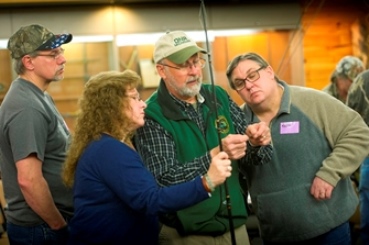
      Taught by staffers at the Johnson Hunt and Fish Center, the class covered about everything a beginning steelhead angler would need to know, from rods and reels to baits and rigs. John Zakrajsek, a part-time interpreter at the center and an officer with the local Trout Unlimited chapter, led the classroom discussions. He showed the students a number of techniques – bottom bouncing, bobber fishing, spinner chucking – and carefully answered questions, both big and small.

      “How much weight do I use?” one asked.

      That’s something you learn by experience, Zakrajsek said.

      “Start out with less than you think you need,” he explained. “If you’re not feeling the bottom, go to a bigger size or, if you’re using split-shot, add more. But you don’t want to use too much; go too heavy and you’ll hang up more.”

      Shaw said some of the steelhead clinic students had attended the center’s ice-fishing clinic and others were participating in the center’s rod-building class.

      “We’re seeing some of the same students over and over,” he said. “They’re building their skills.”

      Shaw brings extra gear for the on-the-water sessions, just in case. If an angler hangs up and breaks off, Shaw will just hand him another rod so he can continue fishing while the staff repairs the angler’s rig. And Shaw told everyone that he was available later in the day if they wanted him to accompany them to the tackle store to make sure they bought the right stuff.

      Kevin Fent, a 56-year-old engineer who lives in Cadillac and brought his wife Marilyn along with him, said he’d take Shaw up on that offer.

      “I’ve never been steelhead fishing,” he said. “I don’t know anything about it and nobody’s ever offered to take me. I needed this.”

      Fent said he plans to take the center’s fly-fishing clinic later on this summer, too.

      The Johnson Hunt and Fish Center has become a regular learning institution, as Shaw schedules programs almost weekly. He is planning another steelhead clinic and has scheduled his first Fins & Feathers Festival for April 12-13, something he hopes will become an annual affair. It will feature hands-on activities, seminars, demonstrations and a sportsman’s swap meet. For information, you can reach him at shawe@michigan.gov. 

      Similar outdoor skills-building programs are offered at many of the DNR’s visitor centers and parks throughout the year. For an idea of what’s available, visit www.michigan.gov/dnrcalendar. To see what’s happening at the Johnson Hunt and Fish Center, visit www.michigan.gov/huntfishcenter.